Sider

fredag 25. mars 2011

Gran Torino

 Today we saw Gran Torino in our english class. Gran Torino is a movie directed by Clint Eastwood from 2008. The movie is about Walt Kowalski who fought in the Korean war and is played by the director, Clint Eastwood. Walt is a grumpy old man who dislikes(as it seems) everyone, especially Asians, and is not exactly happy when a Hmong family moves in next door. The Hmong people are from Laos, China and Thailand. Two of the family members that moves in are a tough girl called Sue and her brother Thao. While Sue is tough, Thao is quite the coward. He is quiet and insecure.
Because of various incidents, Walt and Thao and Walt and Sue gets to know one and each other and relationships are built.

The movie consists a lot of racism between ethnic groups, especially between "white" and Asians. From my opinion Hollywood often portray people of different races as enemies and there is often a lot of violence, guns and swearing. Kind of mafia like with threatening of families ect. I think Hollywood often overdo it when making movies.. At least so I hope.

It can be really hard to be an immigrant, because you need to be able to become a part of the new society and you're also dependent to be accepted by the new society. It is also very important that you do an effort yourself; to learn the new language for example. Also you have to accept the new society and their traditions and morals.

    torsdag 10. mars 2011

    A Jane Austin novel

    For our English class, I am reading Emma by Jane Austin. In this blog entry, I will write about what I think about this book(as far as I've read).
    My expectations for the book were few, but I had heard it wasn't actually easy reading. At the time it was written, people had another way of writing than we have today. The book contains a lot of descriptions and "unimportant" information about various characters. The first three chapters rarely contains any dialogs, which makes the book taught to read because of it's lack of, well, action. The sentences are very long, some 7 lines with letter size 9-8. The language is very formal and deep. the first chapters have still not managed to engage me much, and I'm waiting for the story to really begin.

    I am not sure about the time the story takes place, but the place is somewhere in a two hours diameter from London. Or so I have understood.

    In the book, we meets Emma, who lives alone with her father. The books starts with describing the character gallery in the book, we get to know about a whole lot of people that Emma knows. Quite boring information, but if you've read Anna Karenina, this is no worse. 

    fredag 4. februar 2011

    Trusting information on the internet

    When searching the internet for information it is important to be sure your information is trustworthy. For example if you search for a keyword and you end up on http://uncyclopedia.wikia.com you are goofed. This link can look like Wikipedia, but it is not.
    Also there is a discussion about whether Wikipedia is to be trusted or not. It is. Wikipedia's reputation is too important for this encyclopedia to be ruined. Yes, everyone can write an article there, but if your article is full of bullshit or even just one mistake, it will be deleted within a few minutes. Therefore wiki is a page you can trust.

    But how do you know if you can trust a page? First of all, how is the text written? Informal, formal, passive or partial? Second, have you heard of this page before? Does it have a reputation? Who is the webmaster and what contact information does the page have? Is it a typical homemade webpage with bad graphics or an advanced webpage? Think and be critical!
    It is very important to know who have written the article and on which basis? Because facts and conclusions in a partial article can rarely be used for own writing.

    My best tips is to stick with the pages you know, like Wikipedia or as I often use the Norwegian online encyclopedia. And if I can't find what I need on any of these I usually use the local library because there you can always find something and there's always books you can trust.

    Megacities


    Today's theme in English class is megacities. First of all, what is a megacity? To become a megacity, there has to be more than 10 million inhabitants. In our English book, that we use in class, there is a text about megacities including a quote by Kofi Annan who where the UN secretary-general. Kofi Annan speaks about the problem about people moving from the country and into the cities. The rural population is decreasing while the urban population is increasing. Cities are having challenges accommodating new inhabitants.

    Beneath the quote  there are three statics. The first one is illustrating the percentage of the growth of the urban population . As we can read from these diagrams, in 1800 there was a growth of 2% which have increased to 47% percent in 2000. The diagram is also foreseeing the percent in 2015 and 2030. In 2015 it's foreseen that the percent of urban population growth in the world has increased to 52% while it's 60 percent in 2030. That's a huge increase.

    In the next diagram we're shown the statics of the rural and urban population percent in different regions in the world. We can see the population statics in 1995 and 2015, a twenty year difference. As we can read from this diagram, the region with the widest rural population is Asia with 2249 million people in 1995 and it's foreseen that this will increase to 2380 in 2015. In 1995 they had an urban population corresponding 1180 million people and 1970 by 2015. As we can see, both the urban and rural population is foreseen to increase. After Asia with the largest rural population there is Africa, and then Europe. In Europe the urban population were 518 million people in 1995 and foreseen to increase to 532 million in 2015, while the rural population which were 209 million will decrease to 188 million people. After Europe there is South America and on top, with the lowest rural population, and urban population matching Africa's there is North America. In 1995 the rural population were only containing of 67 million people and the urban had 231 million people(Africa: 247mill.) In 2015 it's foreseen for the rural population to have decreased to 59 million and the urban to have increased to 301 million people.

    What we can see from this diagram is that the rural population in the developing countries is increasing as well as the urban is, while in Europe and America the urban population is increasing and the rural decreases.
    This is of course a global challenge because the developing countries has the biggest population increase and then will get, as Kofi Annan said, problems hosting their new habitants, both immigrants and natives.

    The third static is showing a rank of the world's biggest megacities. The three biggest cities is Tokyo with 33.4 million people, New York with 24.1 million and Mexico City with 21.7 million people.

    torsdag 20. januar 2011

    Multicultural USA and Great Britain

    I have decided to discuss and compare the US and the UK.

    The United States and United Kingdom are both influenced with a multicultural population and have become pretty much multicultural societies. They're societies are influenced with a variety of cultures, religions, races and political views and values. Oblivious this would cause a great deal of both misunderstandings and disagreement.
    In United Kingdom, or Britain you may say, the religious hate crimes have rose as much as 600% since the bomb attacks in 2005. And these crimes are mostly against Muslims.
    Britain's policy of multiculturalism is as following: people of different cultures are allowed to settle without expecting them to integrate into society.

    Could this be a problem? If people continuously immigration but do not integrate , what would happen to the society? In a society I think it is extremely important to have some mostly the same values and be able to understand and accept and speak the same language to make the society work and for people to be able to cooperate.

    Historically the immigrants in Britain have come from Ireland, India, Pakistan and the Caribbean, but today the immigrants more often are younger and with more various backgrounds. Today immigration today is more often motivated by economic factors, while family was a bigger factor before. This makes people from more far off places and different places immigrate. When family was the factor, people immigrated because of solidarity with family.  
    Today Britain is one of the most culturally diverse societies in the world, sharing the statics with the US, a country mainly consisting of immigrants. There is immigrants from all over the world searching for a way to achieve the American dream. USA do not think of multiculturalism as a conflict maker, but as a source of strength and renewal. In America the immigrants who wants citizenship needs to study American history ect.
    This is a difference between England and the US after my impression after reading about these two countries; In England making people integrate to the society is a problem while in the USA, if you want citizenship you're "forced" to integrate. Thought, in the US there is a problem with immigrants not assimilating, notably the Mexican-American. In many schools the "Pledge of Allegiance" is in control and some doesn't even fly the American flag. Also in America there are own societies  containing of multicultural people, for example China Town and the Muslims that had their own little society like we read about in the book Kite Runner.
    Also Hispanics can do business in Spanish, cote in Spanish and take driver license exam in Spanish.  Also there are own schools for different multicultural groups.

    The most common interracial categories in the US are white and black, white and Asian, white and American Indian or Alaska native and white and mainly Latinos. I think the racism is the US and Britain is very much at the same level.


    lørdag 18. desember 2010

    The lion, the witch and the wardrobe.


    Today in English class we watched the movie Narnia, the Lion, the witch and the wardrobe. I am sure you all have heard of this movie and perhaps seen it?

    The film we saw is about the siblings Lucy, Edmund, Susan and Peter. It's war, and the four of them have to leave with a friend of the family out in the countryside, away from the bombs and danger in the city. One day they discover a wardrobe with fur coats. But this is far from a normal wardrobe and inside they all discover a new world; Narnia and that they're all a part of a prophecy. I don't really want to spoil more for you. 

    The movie is the screen version of the book with the same name written by C.S. Lewis. He has written seven books about Narnia. Lewis himself experienced the second world war this fact shows in the movies. The wars are very well made and filmed and the effects used are great. Also the film music (by Harry Gregson-Williams) is great and really getting you into the right mood.

    Lewis, full name Clive Staples Lewis is an Irish-born British who is among other things a novelist, academic and an essayist. And besides the Narnia books he has also written fictional work The Screwtape Letters and The Space Trilogy. Lewis was married to the American writer Joy Gresham. Lewis dies only 64 year old, seven years after his wife. He has experiences both the world wars, and this affects his writing but in a good way. Both the first and the second movie contain more than one battle. These battles are fought by swords and catapults, and fought very differently from the wars Lewis experienced. They are more like battles from the middle ages. But in our world the children experiences a war I think is the second world war, but it could probably be the first one as well. Here his experiences shows.  He was a close friend of J.R.R. Tolkien, and both of them were leading figures in the English faculty at Oxford University and in the informal Oxford literary group.


    Lewis' works have been translated into more than 30 languages and have sold millions of copies. 


    So you're interested in fantasy/was movies with queens and kings, fables and adventure this is probably a movie you like. And soon the third movie will be shown at cinemas in
    Norway!
    http://www.filmweb.no/bilder/multimedia/archive/00091/Legenden_om_Narnia_-_91892a.jpg

    Click the photos to see the source.

    fredag 3. desember 2010

    a Christmas wish

    In English class we are attending a December contest. Link. 
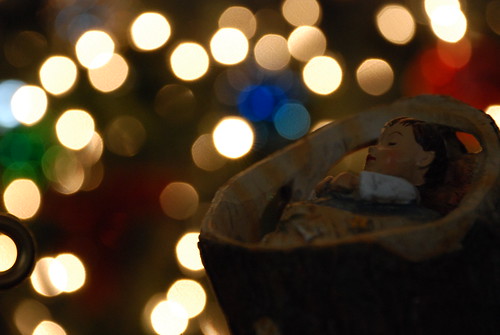
    So I chose task 5: [...] write a poem. And so I did. My poem is written with rhymes and is about peace, Christmas evening, family and Jesus. 


    The windows are covered with hoar frost
    From the radio, Christmas carols fills the air
    In the oven the turkey is almost done roast
    It's the season for love, joy and care

    We will celebrate tonight the evening
    When there was born a little baby boy
    The son of God came to us without screaming
    A king they said, but this did Herodes annoy

    He would kill Jesus, afraid of losing his role
    But Josef foresaw this in a dream
    And escaped to saved his wife and boy
    So together they all ran away in the moonbeam

    They had to escape to save their own life
    So many people have been doing the same
    Running away with both housebound and wife
    People running away in fear is for mankind a shame

    So this night I to the holy spirit pray
    I pray to the son, and his father in heaven
    That our world will be peaceful and safe one day
    And for all our sins to be forgiven

    We will celebrate tonight the evening
    The evening for love, joy and care
    All day I have been washing and arranging
    And polished the silver shining clear

    All that's missing this December night is some company
    They would soon be here with me
    The guests are dear friends and family
    When they come we'll walk around the tree

    The tall and green Christmas tree
    Shining pretty and with lots of presents underneath
    A knock on the door, could that my guests be?
    Come in my dearest family, into the heat

    Warmth and laugher makes a wonderful atmosphere
    We kiss under the mistletoe and think of how lucky we are
    And I wish my words will be heard somewhere
    As I make a wish upon the shining Christmas star

    For a safer and peaceful world.